
Structured Schedules vs. Flexible Routines: What Works Best for Families?

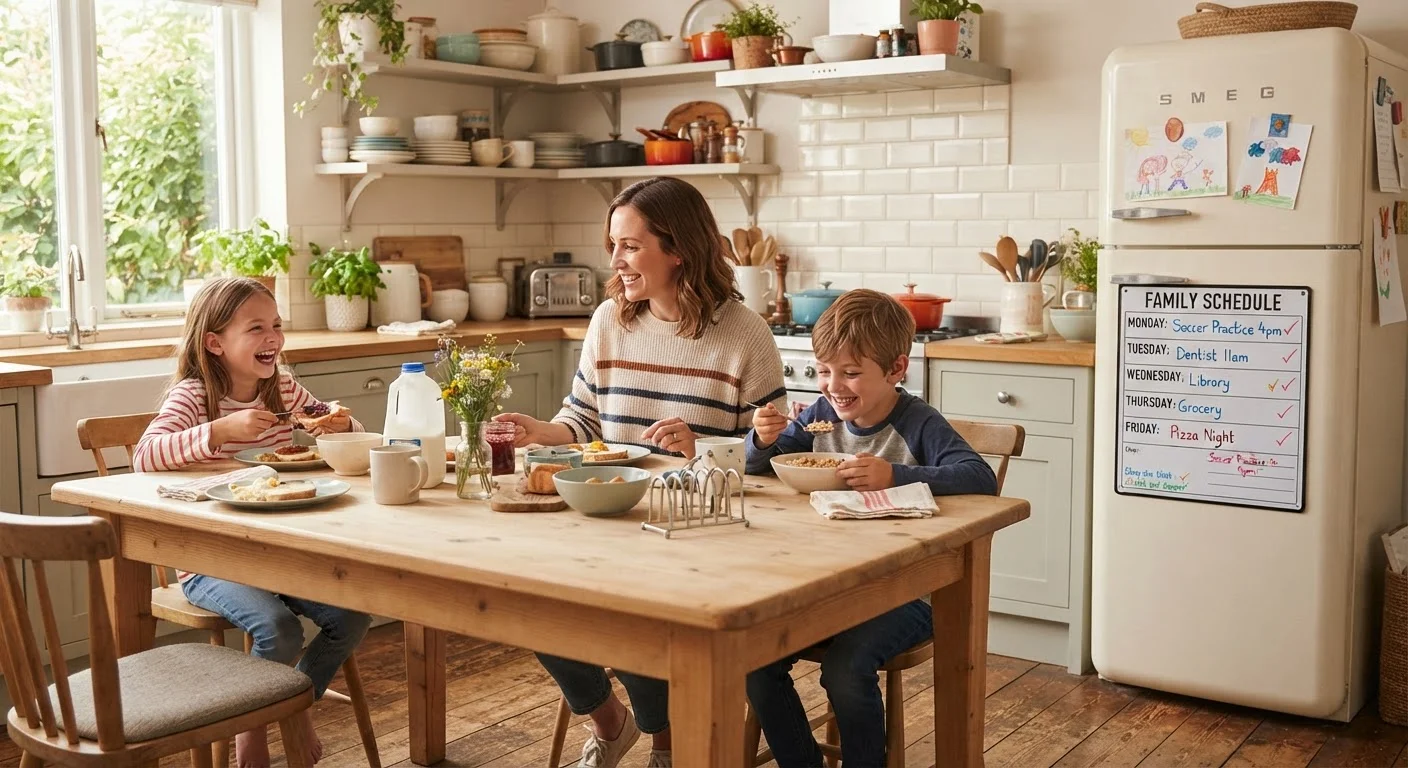
Photo: TotemBuzz.com | Your Lifestyle Companion editorial
Key Takeaways
- Structured schedules reduce decision fatigue and help children feel secure through predictability.
- Flexible routines prioritize sequence and rhythm over exact timing, making them easier to sustain.
- Research broadly supports consistent daily patterns for children's sleep, mood, and behavior.
- Most families benefit from a hybrid approach — firm anchors with breathing room in between.
- The best system is one your household can realistically maintain most days, not a perfect plan.
What Do We Actually Mean by Each Approach?
Before comparing them head-to-head, it helps to get clear on what each term really means — because families often use them interchangeably, and that muddies the whole conversation.
Structured schedules are time-specific plans: breakfast at 7 a.m., homework from 4–5 p.m., lights out at 8:30 p.m. Activities are anchored to the clock, and deviation is the exception rather than the rule. Think of it like a train timetable — everything has a slot, and the goal is to stay on track.
Flexible routines, by contrast, are sequence-driven rather than clock-driven. The family follows a consistent order of events — wake up, eat, play, nap, dinner, bath, bed — but the exact timing shifts to match energy, weather, or the chaos of a given day. The rhythm matters more than the minute hand.
Both approaches aim to reduce daily friction and give children a sense of what comes next, which developmental research consistently links to calmer behavior and better emotional regulation. The difference lies in how that predictability is delivered. For a deeper look at why routines matter for pets, too, see why pets need routine.
| Criterion | Structured Schedules | Flexible Routines |
|---|---|---|
| Basis of order | Clock-driven (specific times) | Sequence-driven (order of events) |
| Resilience to disruption | Lower — one delay affects the chain | Higher — sequence shifts, not collapses |
| Coordination across caregivers | Easier — clear shared expectations | Requires more communication to align |
| Best age fit | School-aged children (5+) | Infants, toddlers, and mixed-age households |
| Adjustment effort | Higher — requires regular recalibration | Lower — adapts more naturally over time |
| Child sense of security | High — strong predictability | Moderate to high — rhythm provides security |
| Parent burnout risk | Higher if rigidly enforced | Lower — built-in breathing room |
The Real-World Trade-Offs
Each approach comes with genuine advantages — and genuine friction points. Here's where families tend to feel the difference most.
Structured Schedules: The Upside
- Reduced decision fatigue. When everyone knows dinner is at 6 p.m., nobody has to negotiate it. That mental energy gets freed up for things that actually need a decision.
- Easier coordination. Multi-caregiver households — think co-parents, grandparents, babysitters — run more smoothly when expectations are written down and time-specific.
- Clear boundaries for kids. Younger school-aged children especially tend to feel safer when the day is predictable. Studies on child development broadly support this link between routine and emotional security.
Structured Schedules: The Friction
- A single disruption (sick kid, late meeting, traffic) can derail the whole day and leave everyone frustrated.
- Overly rigid timetables can feel punishing rather than supportive, particularly for families with varied energy patterns or neurodivergent members.
Flexible Routines: The Upside
- Resilience built in. Because the sequence matters more than the clock, one delayed nap doesn't collapse the whole afternoon.
- Lower barrier to entry. Families new to routines often find it easier to commit to a loose order of events than to an exact timetable.
- Accommodates growth. As children's needs shift — school starting, a new sibling arriving — a flexible framework adapts without a full rebuild.
Flexible Routines: The Friction
- Without some anchoring, routines can gradually drift into inconsistency, especially during holidays or school breaks.
- Children who genuinely thrive on precision may find the looseness unsettling rather than freeing.
A Note on Neurodivergent Children
For families specifically navigating the morning rush, morning routines for families with young children offers practical ways to structure the first hour of the school day.
What the Evidence Suggests
Research on family routines doesn't tend to pit structured schedules directly against flexible ones — instead, it consistently finds that some form of predictable daily pattern benefits children's wellbeing more than the specific format chosen.
Studies in pediatric and developmental psychology have associated consistent routines with improved sleep quality, fewer behavioral challenges, and stronger parent-child relationships. The American Academy of Pediatrics has long recommended regular bedtime routines as a meaningful tool for supporting children's sleep — not because of clock precision, but because of consistency and sequence. You can explore what the research says about bedtime habits in detail at bedtime routines and children's sleep.
~50%
Children with regular bedtime routines sleeping better
Research published in Sleep Medicine Reviews found that consistent bedtime routines were associated with significantly improved sleep outcomes in young children across multiple studies.
3–5x
Frequency of family dinners linked to wellbeing benefits
Studies reviewed by the National Center on Addiction and Substance Abuse found that teens who ate with their families five or more times per week reported better outcomes across several wellbeing markers compared to those who rarely did.
Shared mealtimes are another area where the evidence points toward consistency rather than formality. Research on shared family meals suggests that the regularity of eating together matters more than the timing.
The takeaway? The structure versus flexibility debate may be a bit of a false choice. What families actually need is enough predictability that children feel secure — and enough flexibility that the adults don't burn out enforcing it.
Building Something That Actually Sticks
The most effective family routine is the one your household will actually follow on a Tuesday in November, not just the first optimistic week of September. A few principles help regardless of which end of the spectrum you lean toward:
- Start with anchor points, not a full timetable. Identify two or three non-negotiables — a consistent wake time, a shared meal, a wind-down ritual — and build outward from there rather than scheduling every hour from the start.
- Involve the kids. Children who have some input in setting routines tend to follow them more willingly. Even a toddler can choose between two bedtime books.
- Plan for drift. Every routine loosens during school breaks, illness, or travel. Building in a simple weekly reset — a Sunday evening check-in, for example — helps families return to the rhythm without treating every disruption as a failure.
- Revisit and revise regularly. A routine that worked beautifully when your youngest was two may need updating by age five. Treat it as a living document, not a contract.
For a fuller guide on making routines genuinely sustainable, Building a Family Routine That Actually Sticks walks through the most common pitfalls and how to avoid them.
The content on this site is for informational purposes only and is not a substitute for professional advice. Always consult a qualified professional for guidance specific to your situation.