
Body Weight vs. Gym Equipment: Choosing a Training Style That Suits You

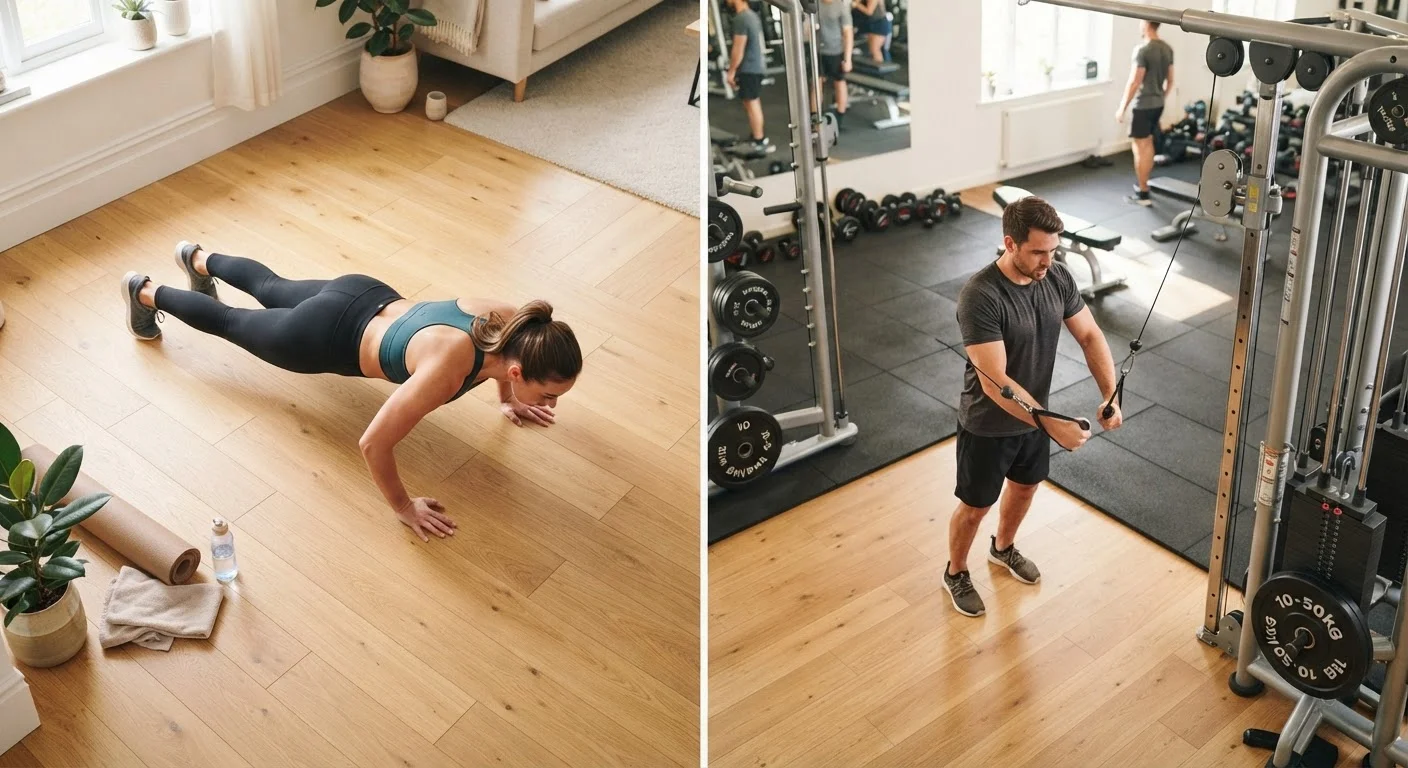
Photo: TotemBuzz.com | Your Lifestyle Companion editorial
Key Takeaways
- Bodyweight training requires no equipment and can be done anywhere, making it highly accessible for beginners.
- Gym equipment allows for more precise load progression, which is useful as strength increases over time.
- Neither approach is universally superior — both can build strength, endurance, and fitness effectively.
- Combining both methods is a practical strategy once you understand the basics of each.
- Always consult a healthcare professional before starting a new exercise routine, especially if you have existing health concerns.
What Each Training Style Actually Involves
Before weighing the trade-offs, it helps to understand what each term means in practice.
Bodyweight training uses your own body as resistance. Exercises like push-ups, squats, lunges, and planks require no equipment and can be performed at home, outdoors, or in a hotel room. The challenge level is adjusted by modifying leverage, tempo, or range of motion rather than adding weight.
Gym equipment training uses external resistance — dumbbells, barbells, cable machines, resistance bands, or weight machines — to load muscles. This equipment is typically found in a fitness facility, though some people invest in home setups over time.
Both approaches fall under the umbrella of strength and resistance training, which is one of the four pillars of a well-rounded fitness routine. Understanding what each style involves helps you match the method to your actual circumstances.
Key Trade-Offs: A Side-by-Side View
No single approach wins on every dimension. Here's how the two styles compare across factors that matter most to beginners.
| Bodyweight Training | Gym Equipment Training | |
|---|---|---|
| Cost | Free or very low cost | Gym membership or equipment purchase required |
| Accessibility | Anywhere, anytime | Requires access to a facility or home setup |
| Progression | Achieved through exercise variations and tempo | Achieved by increasing load incrementally |
| Learning curve | Moderate — form still matters | Moderate to high — equipment technique required |
| Suitability for beginners | High — builds foundational movement patterns | Moderate — guided instruction is advisable |
| Flexibility of schedule | Very high — no travel or wait times | Depends on gym hours and crowding |
Cost and access often drive the initial decision, but consistency and enjoyment tend to determine long-term results. It's also worth noting that many popular fitness ideas — like the belief that gym equipment is strictly necessary for meaningful results — don't hold up under scrutiny. Our article on common fitness myths beginners tend to believe explores several of these misconceptions in more detail.
Progression: The Factor Beginners Often Overlook
One of the most important principles in any fitness routine is progressive overload — gradually increasing the challenge over time so your body continues to adapt. How each approach handles this differs meaningfully.
With gym equipment, progression is relatively straightforward: you add incremental weight to a barbell or select a heavier dumbbell. This measurability makes it easier to track improvement in a concrete way.
With bodyweight training, progression works differently. You might advance from a standard push-up to a decline push-up, slow down the tempo, reduce your base of support, or work toward a more demanding variation like a single-arm push-up. This requires a bit more creativity, but it is genuinely achievable.
Start Simple, Then Build
It's also useful to understand the difference between aerobic and anaerobic effort as you build your routine. Our guide on aerobic vs. anaerobic exercise explains how these energy systems work and when each comes into play.
Which Style Is Right for You?
Rather than declaring a winner, it's more useful to ask: which style fits your life right now?
- If you're just starting out, bodyweight exercises tend to reinforce basic movement patterns — squatting, hinging, pushing, pulling — in a low-stakes environment with no equipment required.
- If you have access to a gym and enjoy a structured, measurable environment, equipment-based training may feel more motivating and allow for clear benchmarks.
- If you have specific goals like building significant muscle mass or working around an injury, gym equipment — combined with guidance from a qualified professional — often offers more targeted options.
Many people find that a combination of both works well over time. Starting with bodyweight fundamentals, then introducing resistance tools as strength and confidence grow, is a reasonable and commonly recommended path.
Whatever you choose, the most important factor is consistency. A routine you enjoy and can sustain will always outperform the theoretically perfect program you rarely follow.
This article is for general informational and educational purposes only. It is not a substitute for professional medical or fitness advice. Speak with a qualified healthcare provider before beginning any new exercise program, particularly if you have an existing health condition, injury, or other concern.
The content on this site is for informational purposes only and is not a substitute for professional advice. Always consult a qualified professional for guidance specific to your situation.