
The Upsell Playbook: What Retailers Hope You Won't Notice

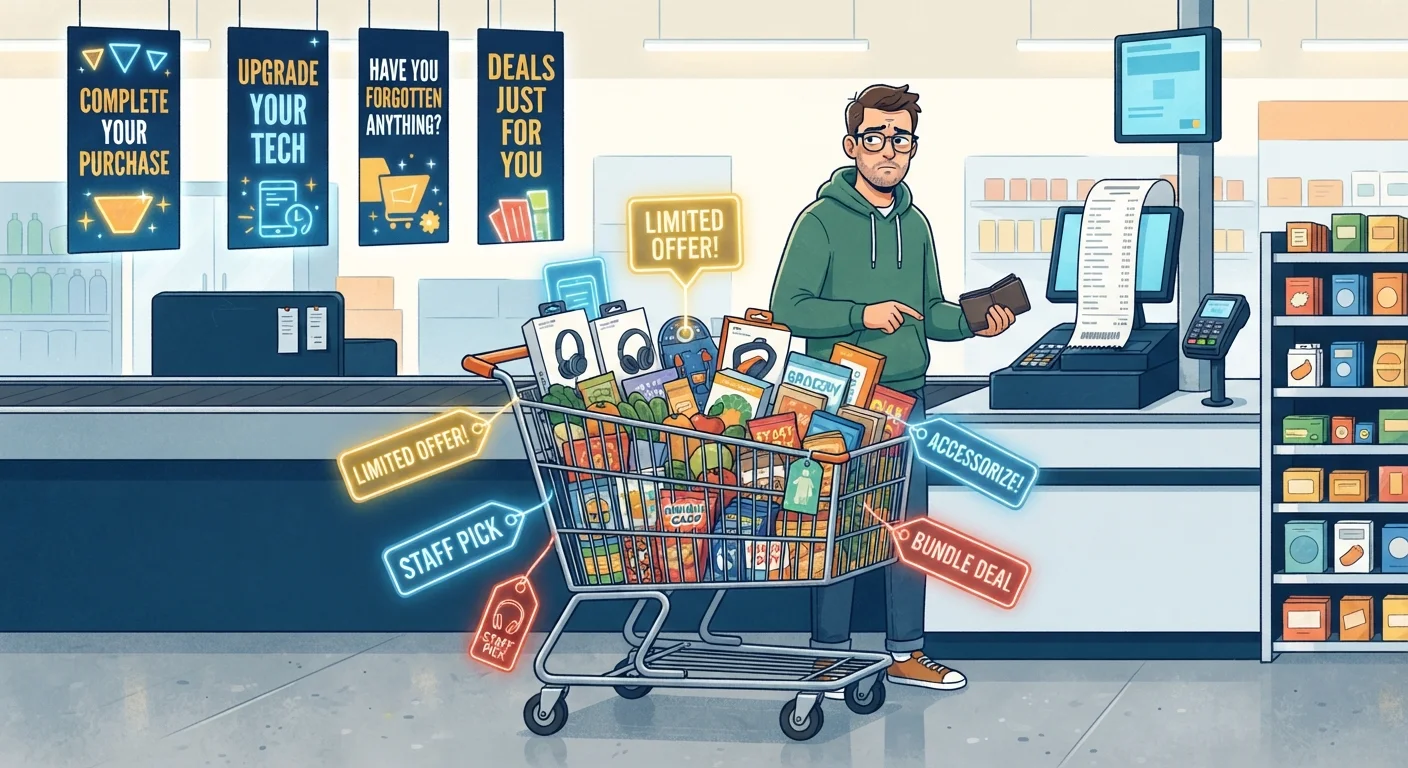
Photo: TotemBuzz.com | Your Lifestyle Companion editorial
Key Takeaways
- Upsells are deliberately timed for moments when you're already committed to buying.
- Extended warranties, bundles, and accessories are among the most common add-on tactics.
- Asking one simple question — 'do I actually need this?' — can protect your budget.
- Some add-ons offer genuine value; the key is evaluating them on your terms, not the retailer's.
Why Upselling Works So Well
You've made a decision to buy something. You're mentally done with the hard part. That's precisely when retailers introduce add-ons, upgrades, and bundles — because research in consumer psychology consistently shows that people are more likely to say yes to additional spending once an initial purchase commitment has been made.
This isn't accidental. It's a structured sales approach called upselling (nudging you toward a pricier version) or cross-selling (suggesting related products). Both are standard retail practice, and neither is inherently dishonest. But understanding how they work puts you back in control of the decision.
The tactics below are among the most common you'll encounter — in stores, at checkout counters, and throughout online shopping flows. Recognizing them doesn't mean rejecting every offer; it means evaluating each one on its actual merits rather than in the heat of a purchase moment. For a broader view of savvy shopping habits, see the complete beginner's shopping roadmap.
The Extended Warranty Offer
Almost every electronics or appliance purchase comes with a pitch for an extended warranty or protection plan. These are typically offered right at the register — again, a moment of peak commitment — and they're priced to feel modest relative to what you've just spent.
Before accepting, consider: most new products come with a manufacturer's warranty already included (often one year), and many credit cards automatically extend that coverage by an additional year at no cost. The value of a retailer's extended plan depends heavily on what it actually covers, what it excludes, and how claims are handled. Read the terms rather than relying on a verbal summary.
Your credit card may already extend a manufacturer's warranty — check before paying for another.
Pre-Checked Add-Ons at Online Checkout
Online checkout flows frequently include pre-selected extras — a protection plan, an accessory kit, an expedited shipping upgrade — that appear in your cart by default. If you're moving quickly through a checkout screen, it's easy to miss them entirely.
Before confirming any online order, scroll through your cart and look for line items you didn't actively choose. This is especially common on electronics, travel booking, and direct-to-consumer retail sites. The pre-purchase checklist for online orders includes this as a key verification step.
Scroll your cart carefully — pre-checked add-ons are easy to miss at speed.
The Bundle That Inflates Apparent Value
Bundling involves packaging several items together at a single price, often framed as a discount compared to buying each piece separately. The catch: the "separately" price is sometimes inflated, or the bundle includes items you wouldn't have chosen on their own.
To evaluate a bundle fairly, look up the individual components and their typical prices at other retailers. If you'd only use two of five bundled items, the "savings" math may not hold up. Genuine bundles do exist and can represent real value — the question is whether the value is yours or the retailer's.
A bundle is only a deal if you'd actually use what's in it — check prices individually first.
Urgency and Scarcity Framing
"Only 3 left in stock." "This offer expires at midnight." These prompts are designed to compress your decision-making time and reduce the chance you'll step back and evaluate the offer carefully. Scarcity and urgency framing are among the most well-documented persuasion techniques in retail environments.
Some stock alerts are accurate. Many are not — or they apply to a specific configuration when other options are readily available. If a time-limited offer feels uncomfortable, that discomfort is worth paying attention to. A purchase that's right for you today will usually still be right tomorrow.
Manufactured urgency is designed to reduce your thinking time — don't let it.
Accessory Recommendations Positioned as Necessities
"You'll need a case for that." "This cable isn't included." Sometimes this is genuinely useful information — some products do require accessories not in the box. Other times, the accessories are optional or available at significantly lower cost elsewhere.
A useful habit: before buying accessories at the point of purchase, note the item name and model, then check whether it's truly required and what alternatives exist. Cables, cases, and adapters in particular are often available at a fraction of the in-store price from other retailers.
Accessories flagged as necessities often aren't — or are available for much less elsewhere.
Subscription Add-Ons Buried in the Flow
Retailers increasingly add subscription services — cloud storage, premium support, content platforms — as optional add-ons during checkout, sometimes with free-trial framing. The trial is free; the renewal after it ends is not, and it may be set to auto-renew without a prominent reminder.
If you opt into a subscription at checkout, note the trial end date and how to cancel. This is a category where the fine print matters considerably. For a deeper look at how these arrangements work, the article on subscription traps and how to spot them is worth your time.
A free trial with auto-renewal is a future charge unless you actively cancel it.
Shop With Your Eyes Open
Upsell prompts are a normal part of retail — but so is your right to pause, compare, or decline. The most effective defense isn't suspicion; it's a habit of asking whether an add-on solves a real problem you have, at a price that reflects its actual value to you.
Build a One-Question Habit
If you're unsure about the terms attached to any purchase — especially warranties, bundles, or subscription add-ons — it's worth reviewing the fine print before you commit. Our guide on understanding return policies and the article on spotting subscription traps are good next reads. And if a deal itself caught your eye first, sale pricing deserves a second look too.
The content on this site is for informational purposes only and is not a substitute for professional advice. Always consult a qualified professional for guidance specific to your situation.