
Navigating Sibling Conflict Without Taking Sides

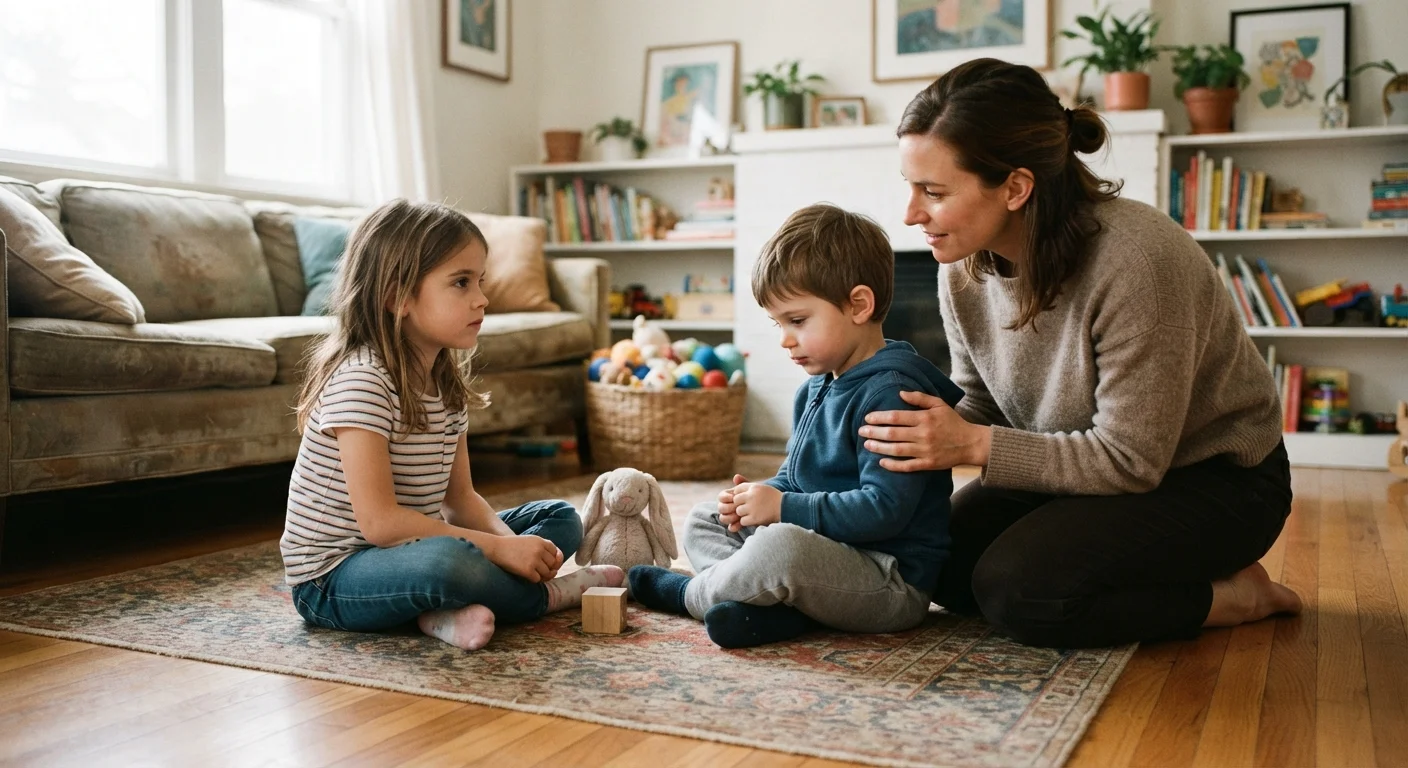
Photo: TotemBuzz.com | Your Lifestyle Companion editorial
Key Takeaways
- Staying neutral doesn't mean ignoring the conflict — it means guiding kids to resolve it themselves.
- Labeling feelings before solving problems helps children feel heard and reduces escalation.
- Consistent, calm responses from parents build long-term trust and fairness in siblings.
- Assigning blame rarely solves the root issue and can deepen sibling rivalry over time.
- Simple family agreements about shared spaces and belongings prevent many repeat conflicts.
Why 'Who Started It?' Is the Wrong Question
Sibling conflict is one of the most consistent features of family life — and one of the most useful, if handled well. Research in child development consistently suggests that learning to navigate disagreement with a sibling is actually valuable practice for managing relationships outside the home. The goal for parents isn't to eliminate conflict, but to stay out of the role of judge.
When parents repeatedly assign blame or declare a winner, children learn to compete for parental approval rather than develop their own repair skills. They also learn to frame every dispute as a case to win rather than a problem to solve. Over time, this can quietly erode sibling relationships in ways that are hard to reverse. You'll find more on how everyday patterns affect family trust in our article on habits that quietly undermine family communication.
The approach outlined here draws on principles used in family mediation: neutrality, active listening, and collaborative problem-solving. None of it requires a background in psychology — just a little practice and a willingness to resist the reflex to fix things immediately.
What you will need
Tools That Make Neutral Parenting Easier
You don't need any special equipment to mediate a sibling argument, but a few simple structures can help enormously — especially when you're tired and patience is thin.
A calm, neutral tone of voice
Helps de-escalate the situation before any problem-solving can happen.
A shared family agreement or household rules
Gives children a reference point that isn't 'mom's rules' or 'dad's rules' but rather a neutral standard everyone agreed on.
A brief cool-down space
A designated low-stimulation area where kids can regulate emotions before discussing the conflict.
Build a 'Cool-Down' Routine Together
If your household is navigating bigger transitions — a divorce, a new blended family, or two separate homes — the dynamics around sibling conflict can shift considerably. Our beginner's roadmap to co-parenting offers practical grounding for those situations.
Step-by-Step: How to Respond in the Moment
The following steps are designed to be used in real time during or just after a sibling dispute. You won't always have the space to follow every step perfectly — and that's fine. Even applying two or three of them consistently makes a measurable difference over weeks and months.
Pause before you intervene
Resist the urge to rush in the moment you hear raised voices. Give children a brief window — 30 to 60 seconds if the situation is safe — to attempt resolution themselves. This builds problem-solving skills and signals that you trust them to try. If things escalate quickly, step in calmly but without urgency in your voice.
Acknowledge both children's feelings first
Before asking what happened, name what you observe: "I can see you're both really frustrated right now." This small step validates that each child's experience matters and lowers defensiveness significantly. Avoid immediately asking "Who started it?" — that question almost always leads to competing stories rather than resolution.
Give each child uninterrupted time to speak
Ask each sibling to describe what happened from their own perspective, while the other listens without interrupting. You might physically hold a small object that the speaking child holds — a simple way to signal whose turn it is. Keep each turn brief and focused: what happened, and how it made them feel. Redirect if the story strays into older grievances.
Reflect back what you heard without judging
Briefly summarize each child's account back to them: "So you felt left out when your sister used the tablet without asking. And you felt like you'd already waited a long time for your turn." This neutral mirroring shows both children they've been heard and often reveals that neither perspective is wholly wrong — both contain real feelings.
Invite them to suggest solutions together
Ask: "What do you both think could make this fair?" Children are often more creative — and more committed to — solutions they generate themselves. Your role here is to evaluate ideas for practicality and fairness, not to hand down a verdict. If they're stuck, offer two or three neutral options and let them choose together.
Establish a simple going-forward agreement
Once a solution is reached, help them put it into plain words: "So the rule is: ask before borrowing, and we swap turns after 20 minutes." Short, specific agreements work better than vague ones. Consider writing it down on a sticky note if the issue is recurring. Revisit and adjust as needed — family agreements are living things, not permanent rulings.
Avoid Labeling One Child as the Problem
Building Habits That Prevent Repeat Conflicts
The most effective conflict resolution happens before an argument starts. Shared responsibilities — even small ones, like taking turns choosing a movie or managing a family pet together — give siblings regular, low-stakes practice at cooperation. Our guide on involving children in pet care by age group is a practical example of how shared duties build both empathy and negotiation skills naturally.
Regular one-on-one time with each child also reduces the competition for attention that quietly fuels many sibling conflicts. Even ten minutes of undivided focus — reading together, a short walk, a shared hobby — can meaningfully lower the emotional temperature in a household. For more ideas on connecting across age gaps, see our piece on family bonding activities that work across age gaps.
When Conflict Becomes a Safety Concern
This article is for general informational and educational purposes only and does not constitute professional psychological, therapeutic, or medical advice. If you have concerns about your child's emotional wellbeing or the severity of sibling conflict in your home, please consult a qualified professional.
The content on this site is for informational purposes only and is not a substitute for professional advice. Always consult a qualified professional for guidance specific to your situation.