
Fixed-Rate vs. Variable-Rate Mortgages: A Practical Comparison

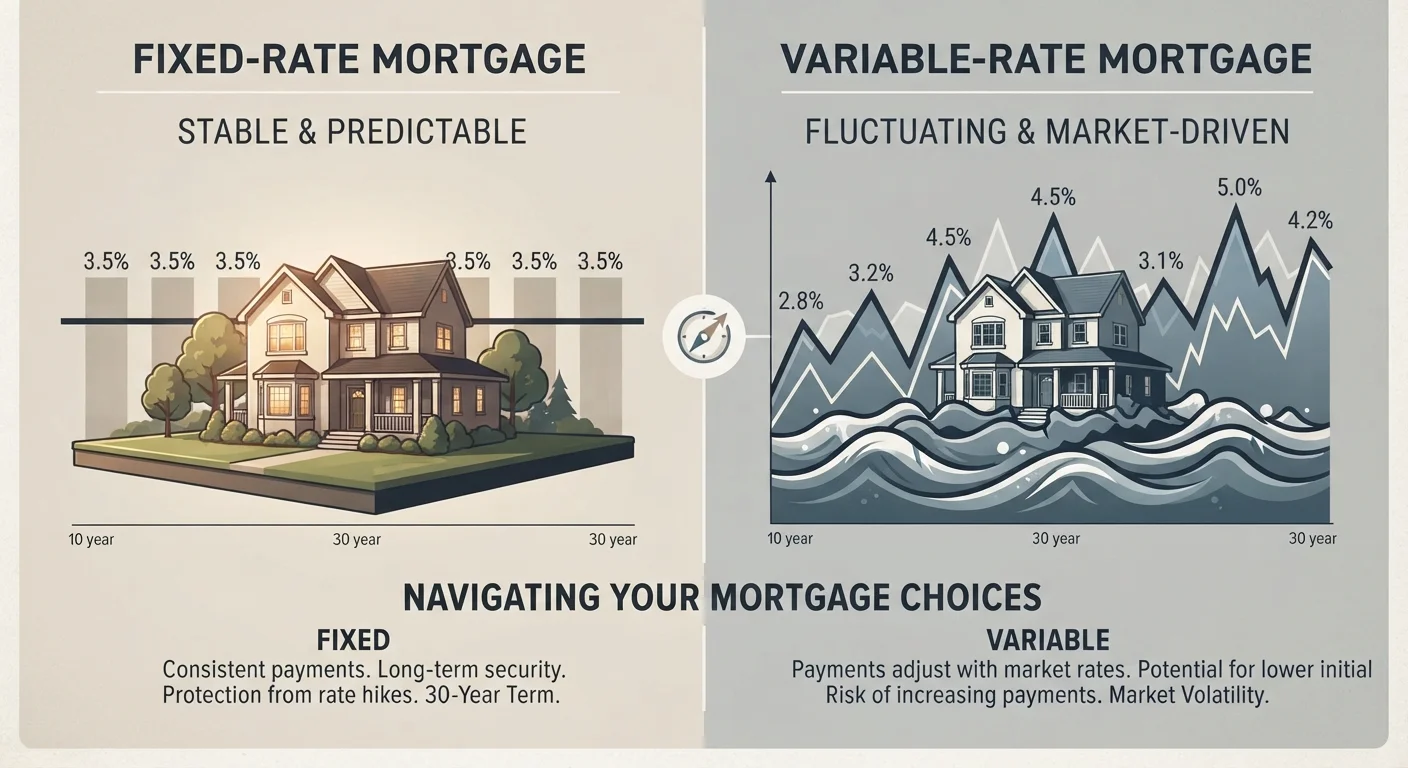
Photo: TotemBuzz.com | Your Lifestyle Companion editorial
Key Takeaways
- Fixed-rate mortgages lock in your interest rate for the loan term, making monthly payments predictable.
- Variable-rate mortgages (also called adjustable-rate mortgages) can rise or fall with market conditions.
- Fixed rates suit buyers who prioritize payment stability; variable rates may appeal to those comfortable with some risk.
- Your timeline in the home, current rate environment, and financial cushion all affect which option fits better.
- Always consult a licensed mortgage professional before committing — your situation is unique.
The Basics: What Each Type Actually Means
If terms like "mortgage" and "equity" are still new to you, it helps to start with a plain-language foundation. Our real estate glossary covers the core vocabulary before you dive deeper.
A fixed-rate mortgage sets your interest rate at the time you close on the loan, and that rate stays the same for the entire repayment period — commonly 15 or 30 years. Your principal-and-interest payment never changes, which makes budgeting straightforward.
A variable-rate mortgage — formally called an adjustable-rate mortgage, or ARM — starts with a set rate for an initial period (often 5, 7, or 10 years), then adjusts periodically based on a market index. When rates rise, your payment goes up. When rates fall, your payment can decrease.
The key distinction is who bears the interest-rate risk. With a fixed loan, the lender absorbs the risk that rates might rise. With an ARM, that risk shifts partly to you, the borrower.
How the Trade-Offs Stack Up
Neither option is objectively superior — each involves real trade-offs. This is worth thinking through carefully, similar to how the risk-and-return trade-off works in investing: lower uncertainty typically comes at a cost.
| Fixed-Rate Mortgage | Variable-Rate (ARM) Mortgage | |
|---|---|---|
| Rate stability | Locked for full loan term | Fixed intro period, then adjusts |
| Starting rate | Typically higher than ARM intro rate | Often lower during intro period |
| Payment predictability | Completely predictable | Can rise or fall after adjustment |
| Risk bearer | Lender bears rate-rise risk | Borrower bears rate-rise risk |
| Best planning horizon | Long-term (10+ years) | Shorter-term (5–10 years) |
| Complexity | Simple and straightforward | More terms to understand (caps, index, margin) |
One factor many first-timers overlook is the ARM cap structure. Most ARMs carry rate caps that limit how much the rate can increase per adjustment period and over the life of the loan. For example, a "2/2/5" cap means the rate can't jump more than 2% at any adjustment, 2% in a single year, and 5% total above the starting rate. These caps provide some protection, but a 5% lifetime increase on a large loan still means a dramatically higher payment.
When a Fixed Rate Makes More Sense
A fixed-rate mortgage tends to be the more comfortable fit if:
- You plan to stay in the home for many years — long enough to outlast the ARM's introductory period.
- Your household budget has limited flexibility, and a payment increase would create genuine hardship.
- You are buying when rates are relatively low and want to lock that rate in permanently.
- You simply prefer predictability over the possibility of future savings — a completely reasonable preference.
Get Pre-Approved for Both Options
If you're still weighing whether to buy at all, our piece on renting vs. buying walks through the broader financial and lifestyle factors to consider first.
When a Variable Rate Might Work for You
ARMs often carry a lower introductory rate than comparable fixed-rate loans. That initial discount can mean meaningful savings — but only if circumstances align:
- Short planned horizon: If you expect to sell or refinance before the fixed period ends, you capture the lower rate without ever experiencing an adjustment.
- Financial buffer: You have enough income or savings to absorb a higher payment if rates move against you.
- Rate environment: In periods when fixed rates are notably elevated, the ARM's initial discount may be especially attractive — though predicting rate direction reliably is not something anyone can do with certainty.
Don't Rely Solely on the Introductory Rate
Understanding how ARMs fit into your overall spending picture is worthwhile. Our guide to fixed, variable, and discretionary expenses can help you see how a fluctuating mortgage payment interacts with the rest of your budget.
Questions to Ask Before You Decide
Rather than chasing whichever product has the lower rate today, work through these questions with a licensed mortgage professional:
- How long do I realistically plan to stay? Five years or fewer often favors an ARM; longer favors fixed.
- What's my worst-case payment tolerance? Calculate what your payment would be if the ARM hit its lifetime cap.
- What does my emergency fund look like? A thinner cushion argues for the certainty of fixed payments.
- How does either option fit my broader financial goals? Mortgage choice doesn't exist in isolation.
This article is for general informational purposes only and does not constitute financial, mortgage, or legal advice. Mortgage products, rates, and regulations vary by lender and by state. Consult a licensed mortgage professional or financial adviser for guidance specific to your situation.
The content on this site is for informational purposes only and is not a substitute for professional advice. Always consult a qualified professional for guidance specific to your situation.