
Fertiliser vs. Compost: Understanding What Each Actually Does for Your Soil

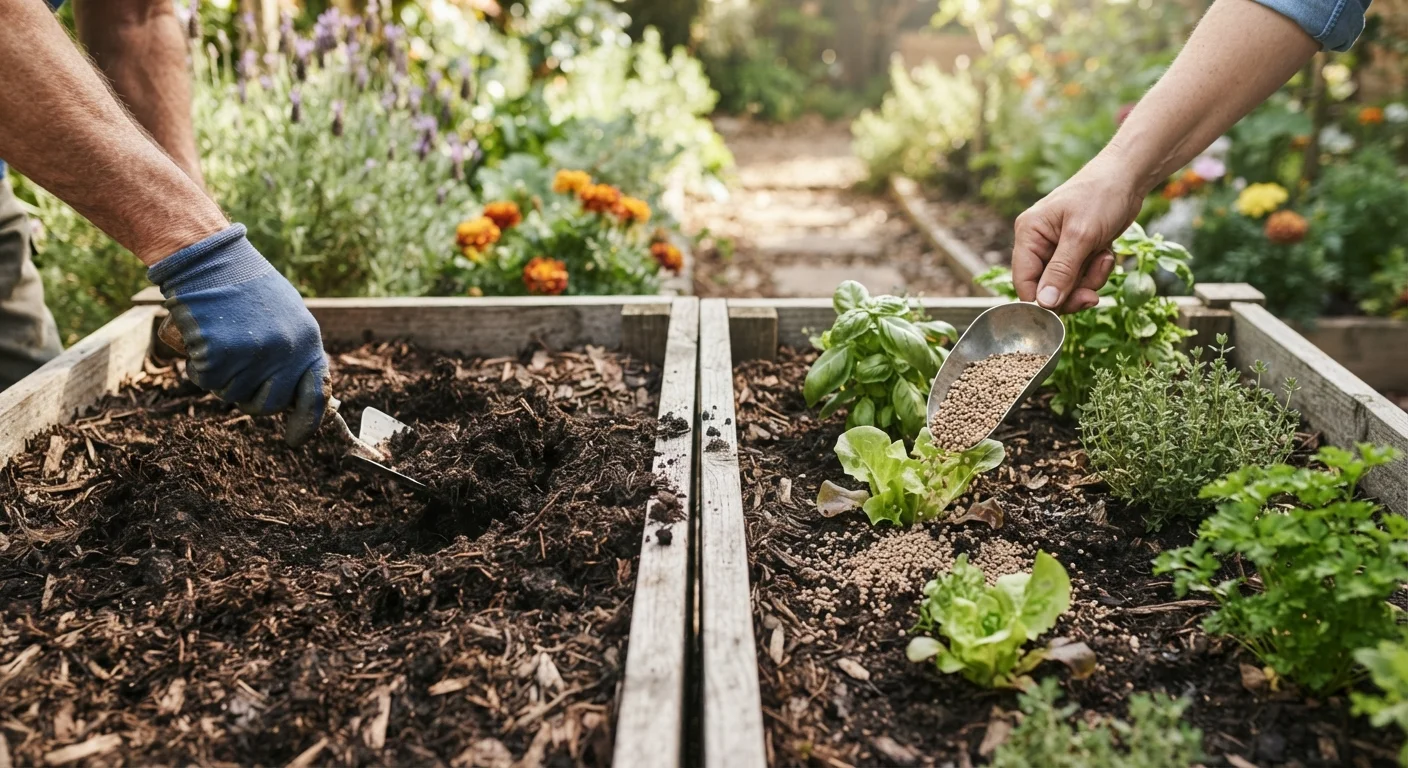
Photo: TotemBuzz.com | Your Lifestyle Companion editorial
Key Takeaways
- Compost improves the structure, biology, and long-term health of soil over time.
- Fertiliser delivers concentrated nutrients to plants quickly but doesn't build soil.
- Most gardens benefit from both, used at the right time and in the right amounts.
- Over-applying fertiliser can harm plants and contaminate groundwater.
- Compost is a slower, more forgiving amendment suitable for nearly every garden situation.
Why the Confusion Exists
Walk into any garden center and you'll find bags labeled "soil enricher," "plant food," "compost," and "fertiliser" stacked side by side. For a beginner, the differences can seem technical or even irrelevant — aren't they all just things you add to soil to help plants grow?
Not quite. Compost and fertiliser work through entirely different mechanisms. Mixing them up — or assuming one replaces the other — is one of the most common mistakes new gardeners make. Understanding what each one actually does puts you in a much stronger position to make decisions that help your garden rather than inadvertently harm it. For more on widespread misconceptions, see our guide to common gardening myths.
What Compost Does for Your Soil
Compost is decomposed organic matter — kitchen scraps, fallen leaves, grass clippings — broken down by microorganisms into a dark, crumbly material. Its primary job is to improve soil structure and biology, not to feed plants directly.
Here's what that means in practice:
- In sandy soils, compost adds organic matter that helps retain water and nutrients that would otherwise drain away.
- In clay soils, it loosens compaction, improving drainage and root penetration.
- In any soil, it feeds the microbial life that makes nutrients available to plant roots over time.
Compost releases nutrients slowly and gently — it's nearly impossible to over-apply it in normal garden quantities. Think of it as a long-term investment in your soil's health rather than a quick fix. Our article on making compost at home walks through the full process if you'd like to start producing your own.
Start With a Soil Test
What Fertiliser Does for Your Plants
Fertiliser delivers concentrated nutrients — most commonly nitrogen (N), phosphorus (P), and potassium (K) — in forms plants can absorb quickly. These three elements are listed on every fertiliser label as an N-P-K ratio (for example, 10-5-5).
Unlike compost, fertiliser targets a specific nutritional gap. It doesn't improve soil structure, doesn't feed soil microbes, and in some cases can actually suppress microbial activity if overused. What it does do is give plants a rapid nutritional boost when one is clearly needed.
More Fertiliser Is Not Better
Common scenarios where fertiliser makes sense include heavy-feeding crops such as corn and squash during active growth, container plants whose nutrients deplete faster in limited soil volume, and gardens where a soil test has confirmed a specific deficiency.
Comparing the Two Side by Side
The table below summarises how compost and fertiliser differ across the criteria that matter most to a home gardener.
| Compost | Fertiliser | |
|---|---|---|
| Primary purpose | Improve soil structure and biology | Deliver concentrated nutrients quickly |
| Nutrient content | Low and slow-releasing | High and fast-releasing |
| Effect on soil life | Feeds and sustains microbes | Can suppress microbes if overused |
| Risk of over-application | Very low in normal quantities | Moderate to high — can burn plants |
| Long-term soil health | Builds it progressively | Does not build soil structure |
| Best use case | Foundation for all garden beds | Targeted fix for specific deficiencies |
Neither option is universally superior — they complement each other. A garden built on good compost will often need less fertiliser over time, because healthy soil biology naturally cycles nutrients more efficiently. This principle applies whether you're growing annuals or long-lived perennials; see our overview of annual vs. perennial plants for more context on planning your planting approach.
A Practical Approach for Beginners
If you're just starting out, a straightforward rule of thumb is: build with compost, supplement with fertiliser only when needed.
- Start every new bed with compost. Work 2–3 inches of compost into the top 6–8 inches of soil before planting. This sets a strong foundation.
- Top-dress annually. Adding a 1-inch layer of compost each season maintains organic matter without any risk of over-application.
- Use fertiliser selectively. If plants look pale, are growing slowly, or a soil test points to a deficiency, then introduce a fertiliser matched to that specific need.
- Follow label directions precisely. More fertiliser is not better — excess nitrogen, in particular, can burn plant roots and leach into waterways.
Beginning with this layered approach keeps things manageable and avoids the most common pitfall: chasing symptoms with fertiliser when the underlying problem is poor soil structure that only compost can fix.
The content on this site is for informational purposes only and is not a substitute for professional advice. Always consult a qualified professional for guidance specific to your situation.